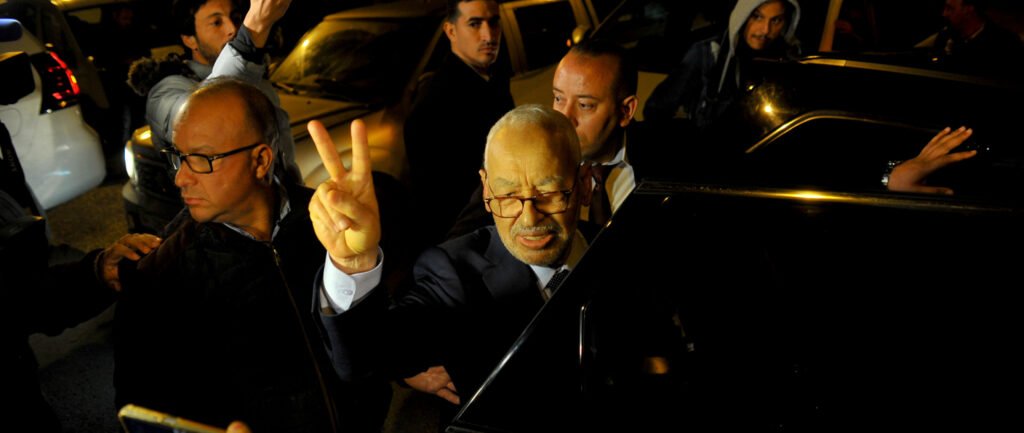
Amnesty International has issued an urgent call for Tunisian authorities to immediately release prominent opposition politician Rached Ghannouchi, annul his conviction sentences, and halt politically motivated legal proceedings that have been marred by serious breaches of due process. The organization is also demanding that he be granted adequate medical care while in custody.
A History of Politically Motivated Prosecutions
Ghannouchi, the 84-year-old leader of Ennahda movement and former President of the Chamber of Deputies, has been held arbitrarily since his arrest in April 2023. Authorities have initiated at least twelve separate criminal cases against him, resulting in multiple convictions and prison sentences totaling 107 years. Notably, in June 2026, he received a life sentence in the “Secret Apparatus” case.
Hiba Maaraf, Director of Amnesty International’s Middle East and North Africa Regional Office, described the latest verdict as a significant escalation in the misuse of the criminal justice system against opposition figures. She noted it marks the first life sentence imposed on a major political leader since Tunisia’s 2011 revolution. Maaraf stated that these successive trials demonstrate how far authorities are willing to go to suppress political dissent, highlighting a judicial system that has become heavily politicized with near-total disregard for fair trial guarantees.
UN Condemnation and Procedural Failures
Amnesty’s stance aligns with findings from the UN Working Group on Arbitrary Detention. In Opinion No. 63/2025, the group concluded that Ghannouchi’s detention is arbitrary under international law, citing a lack of legal basis, violations of fair trial standards, and discrimination based on political opinion.
The convictions were reached through procedures riddled with procedural irregularities. These included denying Ghannouchi access to legal counsel, holding trials in absentia without proper notification, relying on manipulated video footage, using anonymous witnesses, and presenting claims lacking evidentiary support. The defense was unable to effectively challenge this evidence. The charges range from freedom of expression offenses related to public statements protected by law, to financial crimes linked to a charitable donation made to the Tunisian Red Crescent in 2016.
Critical Health Deterioration
Ghannouchi’s situation has worsened due to severe health issues. He suffers from Parkinson’s disease, sleep apnea, and acute leg pain. His confinement in poorly ventilated cells during heatwaves exceeding 50 degrees Celsius has exacerbated these conditions. On July 17, he lost consciousness twice during a legal consultation. Between July and August 2026, he was hospitalized five times, during which authorities arbitrarily prevented his family and legal team from visiting him.
Maaraf concluded that the case reflects a sharp decline in human rights under President Kais Saied, facilitated by the undermining of judicial independence. While the president frequently labels critics and opponents as traitors or terrorists, the judiciary has increasingly submitted to the executive’s political interests. Amnesty reiterates its demand for Ghannouchi’s immediate release and urges Tunisia to fulfill its international human rights obligations.
This report was produced by the HuMedia newsroom.